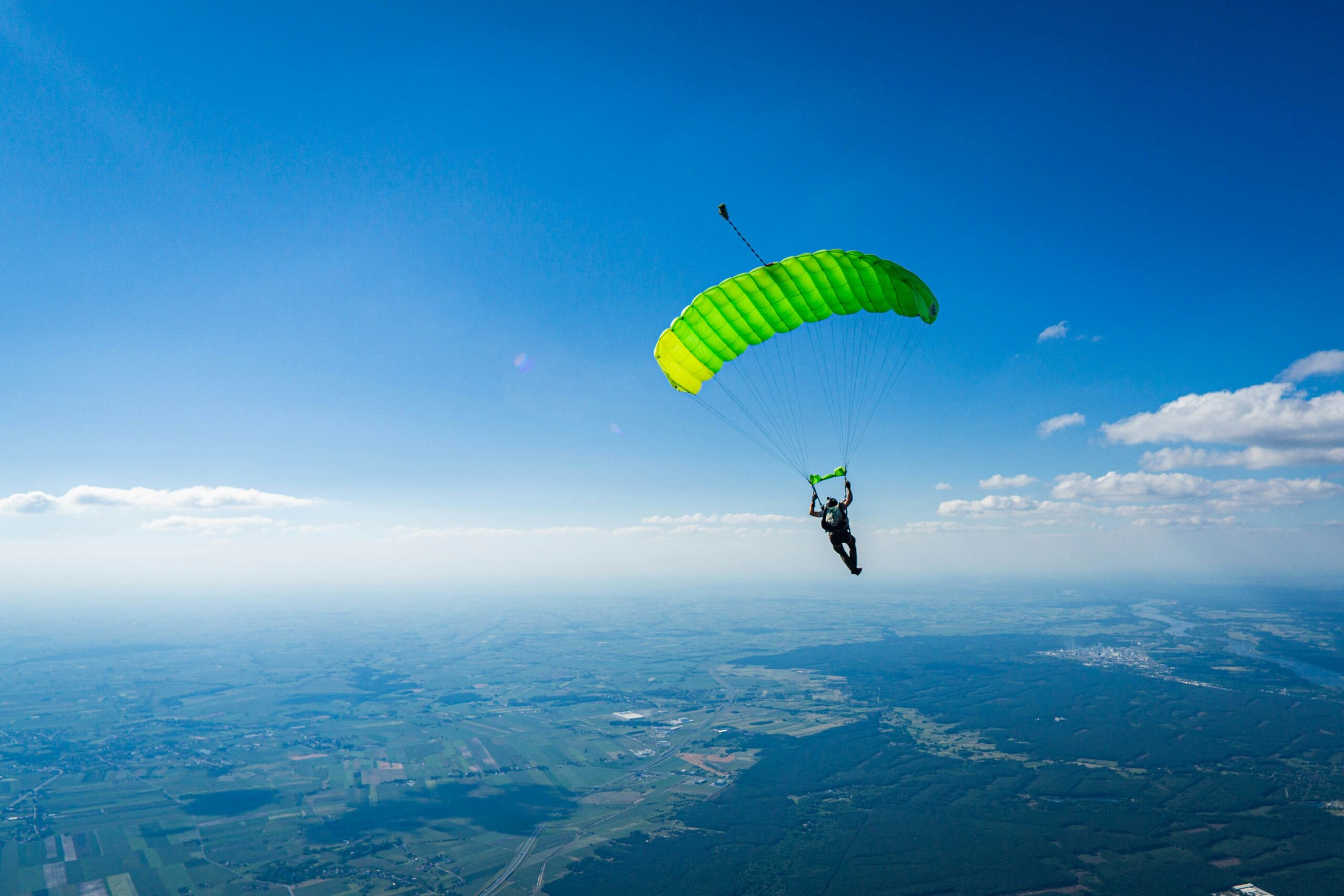
Downsizing is one of the biggest gear decisions in a skydiver’s progression. A smaller canopy flies faster, turns faster, lands faster and leaves less room for mistakes. Before you buy one, it pays to know your numbers, and to know what experienced coaches and the national associations recommend.
What wing loading is
Wing loading is your exit weight – you plus everything you jump with: rig, suit, helmet, camera, weights – divided by the size of your canopy. Manufacturers state recommended ranges in pounds per square foot (lb/sq ft). The metric equivalent is kilograms per square metre (kg/m²). For example, JYRO recommends 1.0–1.6 lb/sq ft for the Safire 4, which is 4.9–7.8 kg/m².
How to use our calculator
- Open the wing loading calculator on our home page.
- Choose lb or kg next to “Exit weight”. If you switch, the number you entered is converted, and the site remembers your choice for your next visit.
- Enter your exit weight and the canopy size in square feet – canopies are always sold in sq ft.
- Read your wing loading in lb/sq ft and kg/m², with a short note on where it sits.
Example: a jumper with an exit weight of 190 lb (86.2 kg) on a 150 sq ft canopy flies at 1.27 lb/sq ft. The same jumper on a 135 sq ft canopy flies at 1.41 lb/sq ft – a noticeably faster wing.
Same wing loading, different canopy
Wing loading is not the whole story. JYRO gives a good example: a 60 kg pilot on an 89 sq ft Crossfire 3 and a 100 kg pilot on a 149 sq ft Crossfire 3 fly at about the same loading, yet the smaller wing reacts faster – it has less span, mass and inertia, and so less time to correct a mistake. The type of canopy matters too: elliptical or semi-elliptical, cross-braced or not, 7 or 9 cells.
What USPA recommends
The Skydiver’s Information Manual of the United States Parachute Association (SIM section 5-9) treats these loadings as high-performance:
- canopies over 230 sq ft at 1.1 lb/sq ft or more;
- 190–229 sq ft at 1.0 or more;
- 150–189 sq ft at 0.9 or more;
- anything under 150 sq ft, at any loading.
So by USPA’s definition, the 150 sq ft canopy in our example above is already a high-performance wing. Canopies approaching 1.5 lb/sq ft, or around 120 sq ft and smaller, call for specialised training.
For downsizing on the same canopy design, the SIM gives these generally acceptable steps:
- over 230 sq ft: 20–30 sq ft at a time;
- 150–229 sq ft: 20 sq ft or less;
- 120–149 sq ft: 15 sq ft or less;
- under 120 sq ft: smaller steps still.
It also advises changing either the size or the design – never both at once – and judging readiness by skill and currency rather than jump numbers. If you have doubts, or have had a break, make another 50 to 100 jumps on your current canopy; there is no penalty for waiting. A USPA article on choosing a canopy adds that many landing injuries happened at 1.4 lb/sq ft or more, to jumpers flying a smaller, new-to-them canopy after only a few jumps.
Signs you may be ready – and signs you are not
In its own guide, JYRO lists signs of readiness: you fly accurate, controlled patterns consistently, you land confidently in crosswind and downwind conditions, you manage traffic, altitude and spacing reliably, you have explored the full control range of your current canopy, and coaches who know your flying support the move. Warning signs are downsizing because friends or pros do, or because you have reached a certain jump count without consistent fundamentals.
Before you buy
- Talk to your instructor or a canopy coach, and take a canopy course.
- Check the recommended wing loading for the model on its page in our catalog.
- Run your numbers in the calculator for the size you have in mind.
- Remember that a bigger canopy is sometimes the better choice.
This article is for education only and does not replace training. Always follow your instructor, your national association and the manufacturer’s recommendations.
Sources: USPA SIM 5-9: Canopy Piloting; Choosing a Canopy (USPA); When to Downsize Your Skydiving Canopy (JYRO blog, January 2026). Photo: Kamil Pietrzak / Unsplash.